

Technology
We develop the full stack of hardware, firmware, and software in-house.

We design and build drones to fit the site
Fast customization for the site and mission
We adapt the airframe quickly to the sensor set and mission requirements. Because we understand the behavior of every layer, we find and fix problems fast and shorten the time to deployment.
Low-MOQ production
We build in small quantities with no minimum order. Start with a single-unit PoC, validate it on site, and scale from there.
High-end components, software to match
Core components are the latest high-performance parts, with firmware and algorithms designed to match, so flight control and SLAM run in real time on board.
In-house LiDAR SLAM
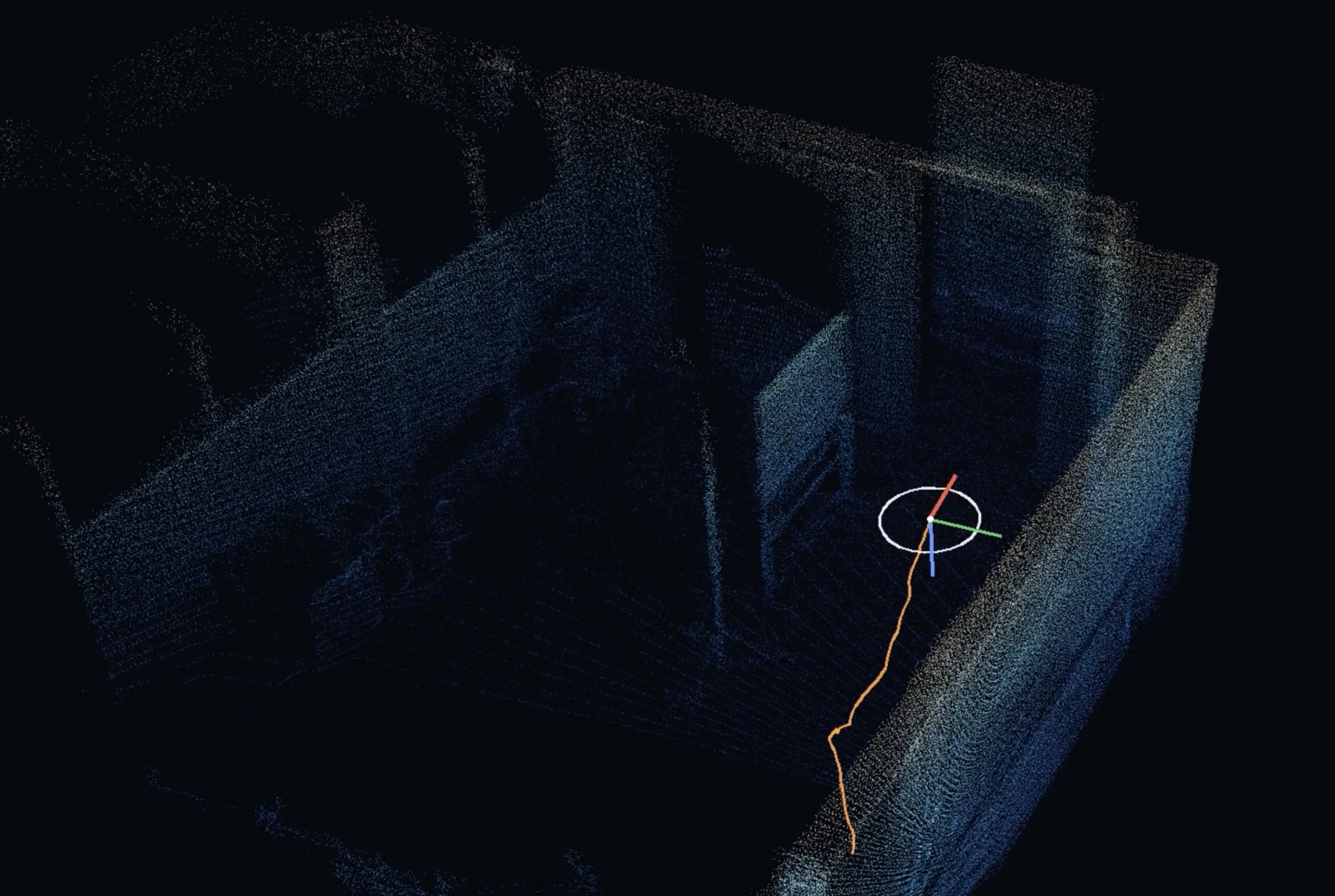
High-frequency precision designed for drones
Most LiDAR SLAM is designed for ground robots or handheld scanners. Ours was developed from the start for drone flight control. Large estimation errors in the high-frequency band cause vibration and drift, which lead to collision risk in confined spaces, degraded inspection data, and a shorter airframe life. Our SLAM cuts that error to 2.5 to 17 times below the latest published algorithms (KISS-ICP, MAD-ICP, GenZ-ICP), reducing collision risk and protecting data quality and airframe life.
Works in swirling dust
In tunnels, silos, and construction sites, airborne dust fills a large share of the LiDAR returns. Most SLAM algorithms fail in these conditions. Ours works in swirling dust by design and keeps operating stably even with 70% of the LiDAR field of view obscured.
6 patents filed or granted
- Modular drone structure using 3D printing
- Drone structure for flying flush against walls and more
Foundational AI safety research
We conducted AI safety research that applies broadly to industrial-site problems, including drones.
arXiv:2504.20924 (opens in a new window)Deployment and pilot inquiries
We consult based on your site conditions.